

Introduction
The EU’s sustainability reporting landscape has evolved rapidly over the past few years, with overlapping regulations and complex timelines. On 26 February 2025, the European Commission launched the “Omnibus Package” to simplify, align, and rationalise these rules. This blog post chronicles this evolution, summarises where the implementation of CSRD, CSDDD, and the EU Taxonomy currently stands – and what the simplification drive means for companies and the broader goal of sustainability transparency. For more detailed information, download our White Paper on this topic.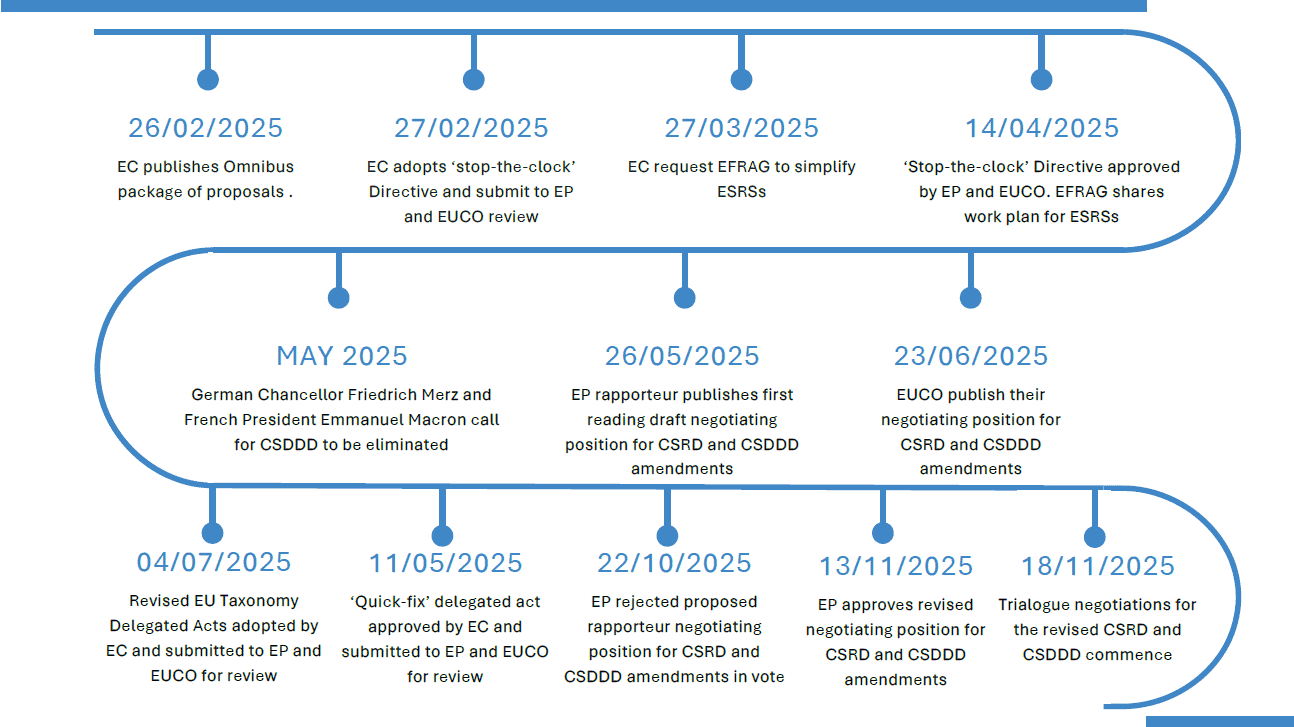
Background
The EU sustainability framework comprises several pieces of legislation, which are broadly under the following categories:- Corporate Sustainability Reporting Directive (CSRD)
- EU Taxonomy Regulation and Delegated Acts
- Corporate Sustainability Due Diligence Directive (CSDDD)
- Sustainable Finance Disclosure Regulation (SFDR)
Digitisation
Digitisation is central to the EU’s transparency goals: structured, machine-readable sustainability data enables comparability, automation, and assurance. The CSRD and the EU Taxonomy are required to be reported in Inline XBRL Format under the EU’s European Single Electronic Format Regulation. The CSRD does not specify a separate timetable for the introduction of this digital requirement, so it would be reasonable to assume the format is required from the outset, in line with the Tallinn Declaration on eGovernment’s digital-by-default principle. However, when the European Securities and Markets Authority (ESMA) published their “Consultation Paper on ESEF RTS – marking up rules for sustainability reports and financial notes and EEAP RTS amendments“ on 13 December 2024, they proposed a different timetable for digitisation. This was dependent on the publication date of the revised RTS in the Official journal:| Scenario 1: Amended RTS is published in first half of 2026 | Scenario 2: Amended RTS is published in second half of 2026 | |
| Public Interest Entities (PIEs) |
Phase 1 – FY 2026 (published 2027) |
Phase 1 – FY 2027 (published 2028) Phase 2 – FY 2029 (published 2030) Phase 3 – FY 2031 (published 2032) |
| Non-Public Interest Entities | Phase 1 – FY 2027 (published 2028) Phase 2 – FY 2029 (published 2030) Phase 3 – FY 2031 (published 2032) |
Phase 1 – FY 2028 (published 2029) Phase 2 – FY 2030 (published 2031) Phase 3 – FY 2032 (published 2033) |
Each of the three phases above is accompanied by a detailed description of which groups of data points are included in the phase and the expectations for digital filing. The plan effectively proposed different digital marking up depending on the type of company, the timing of the RTS getting published, the data point being considered and the phase of implementation that company is currently in. ESMA received a lot of feedback in relation to the complexity of the proposed phasing-in plan, and their decision on the actual implementation plan following the consultation is still unknown.
The digitisation requirement, including use of the ESEF/iXBRL format, is not affected by the Omnibus proposals. Digitisation is still high on the EU agenda and enhances the utility of all the data collected through sustainability reporting requirements. The Omnibus does, however, include a clarification that until the rules on the marking up of sustainability reporting are adopted by way of a Delegated Regulation, undertakings should not be required to mark-up their sustainability reporting.
The Omnibus package proposals
A combination of various factors, including shifting politics, industry and business lobbying and a concern by policymakers that additional reporting burdens could undermine EU competitiveness, led to the EC publishing a proposal in June 2023 for streamlining and aligning reporting requirements for ESG reporting. The EC published a new package of proposals on 26 February 2025, aiming to simplify the rules on sustainability. The Omnibus package has several components:- a ‘stop-the-clock’ Directive aimed at postponing the reporting requirements for waves 2 and 3 of CSRD by two years
- a proposed Directive with substantial simplification amendments for CSRD and CSDDD
- a proposed Delegated Regulation amending the EU Taxonomy Regulation and Delegated Acts
Threshold of proposed amendments to CSRD and CSDDD (COM(2025)81)
CSRD proposed amendments
A key proposed change for CSRD, was to increase the number of employees threshold from 250 to 1000. This was estimated to reduce the undertakings within the scope of CSRD by 80%. As part of the proposals, the Directorate-General for Financial Stability, Financial Services and Capital Markets Union (DG-FISMA) requested from the European Financial Reporting Advisory Group (EFRAG) to revise the European Sustainability Reporting Standards (ESRSs) and substantially reduce the number of mandatory data points. They were to do this by following a set of general recommendations, but without undermining the interoperability with global reporting standards and without compromising the principle of materiality assessment for each undertaking. In April 2025, EFRAG published their proposed amended ESRSs. The following ‘levers’ were followed to identify areas of simplification:- a simplified double materiality approach
- better readability of the resulting disclosures
- linking Minimum Disclosure Requirements (MDRs) to the topical standards, and renaming them to General Disclosure Requirements (GDRs)
- restructuring the standards themselves to achieve better understandability
- introducing a number of burden reduction reliefs
- enhanced interoperability with other global sustainability reporting frameworks
CSDDD proposed amendments
For CSDDD the Omnibus proposes:- A postponement of deadlines
- Retaining scope thresholds
- Reducing the scope of due diligence obligations
- Narrower definition of ‘stakeholder’
- A more ‘risk based’ approach for risk identification and assessment
- Reduced frequency of monitoring/reviewing due diligence measures
- Restrictions to Member States on introducing further local requirements on sustainability due diligence
Other proposed amendments
The proposals also amend the Audit Directive and the Accounting Directive. For audit, it removes the EC’s empowerment to eventually move from a limited assurance to a reasonable assurance requirement. The Accounting Directive is changed to reflect the new proposed thresholds for reporting under CSRD and CSDDD as well as to give companies with more than 1000 employees but less than €450m turnover more flexibility when reporting under the EU Taxonomy Regulation.Current status of the above proposals for CSRD and CSDDD
The latest update on where the COM(2025)81 amendments are in the EU legislative process is that the EC and the EUCO have locked-in their negotiating positions for the trialogue discussions. The EC, as it initially proposed, favours an increased threshold to more than 1000 employees for the requirements of CSRD disclosures. The EUCO agrees with this threshold but also proposes an additional threshold of €450m turnover which will align the reporting thresholds with those of CSDDD. The European Parliament (EP) approved its negotiating position in a vote on 13 November. The main amendments that they are proposing include a threshold of 1,750 employees or more, an additional €450m turnover threshold, as well as exemptions for listed subsidiaries and financial holdings. In addition to the cap imposed for requests from the value chain to the extent of VSME disclosures, the EP also proposes using the same thresholds of 1,750 employees and €450m turnover for the entities the requests are made from. The trialogue negotiations between the three EU institutions have already started. They are aiming to conclude the negotiations in early December 2025.EU Taxonomy Regulation
The EC published a consultation on 26 February 2025 for a delegated regulation to amend the Taxonomy Disclosures Delegated Act, the Taxonomy Climate Delegated Act and Taxonomy Environmental Delegated Act. This was finally adopted by the EC on 4 July 2025 and was submitted to the EP and the EUCO for review (a four + two months scrutiny period). The aim is for it to apply from 1 January 2026, covering the 2025 financial year, but with the companies given the option to opt to defer its application for another year. The main changes proposed to the EU Taxonomy Regulation are:- Materiality thresholds have been introduced
- The Do-No-Significant-Harm (DNSH) criteria are simplified
- Streamlined Reporting Templates (reduced number of tables and data points)
- Opt-out option for financial companies for a transitional period of two years
- Option to defer implementation by one year
- General improvements to clarity, usability, consistency and support for transition planning