
A reporting deadline approaches, and hundreds of spreadsheets start arriving from banks, insurers, or listed companies.
Every institution has used the same template, yet no two submissions are quite alike. Rows have been inserted, formulas overwritten, units changed, and validation errors only become visible once the data reaches the regulator.
This is the challenge every reporting authority eventually runs into. Analysts spend more time checking and cleaning data than supervising the institutions that submitted it, while reporting teams struggle with inconsistent filings and avoidable errors.
That’s why regulators around the world have adopted XBRL. A machine-readable reporting framework lets filers validate submissions before they are sent and gives supervisors consistent, structured data from the moment it arrives.
But a reporting mandate doesn’t implement itself. Success depends on the digital data standard (XBRL taxonomy), the collection platform, and the support filers receive before the first reporting deadline.
This guide walks through each stage of implementation, from defining the reporting mandate to building the collection platform and preparing filers for a successful rollout.
What digital regulatory reporting with XBRL actually means?
Digital regulatory reporting with XBRL replaces static forms, spreadsheets and PDF documents with structured, machine-readable data. Instead of publishing a reporting template and a separate guidance document, regulators publish a taxonomy that defines every data point they collect, the relationships between them, and the validation rules each submission must satisfy.
Filers use that same taxonomy to prepare their reports. Their software applies the regulator’s validation rules before submission, so most errors are identified and corrected before the report reaches the regulator.
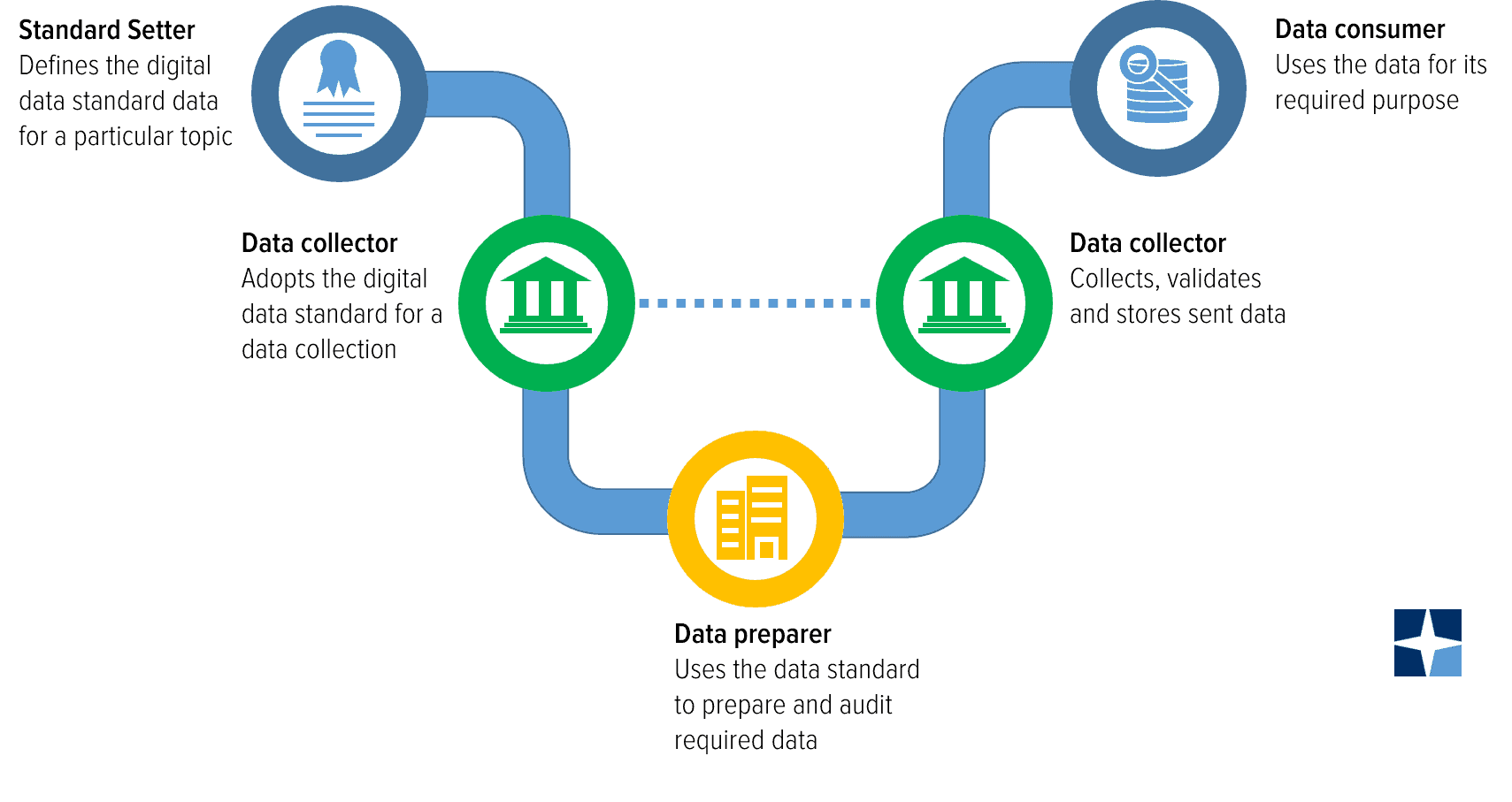
Because both sides work from the same data rulebook, regulators receive data in a consistent format that can be validated, processed, and analyzed automatically, without manual transcription or reconciliation.
The XBRL standard is governed by XBRL International and is free to implement. Depending on the reporting requirement, regulators can collect data in several formats:
- xBRL-XML for traditional XBRL filings.
- xBRL-CSV for high-volume, granular reporting.
- xBRL-JSON for web applications and analytics.
- iXBRL for reports that need to be both human- and machine-readable, such as annual reports.
Why regulators are mandating digital regulatory reporting now?
The biggest driver is the amount of data regulators now have to process.
Increased financial and non-financial reporting has expanded both the volume and complexity of disclosures. Manual review no longer scales, and regulators need information they can validate, compare, and analyze from the first reporting cycle.
Structured data also changes how supervision works. Peer benchmarking, sector-wide risk analysis, and early-warning indicators all depend on consistent data that systems can process automatically. A regulator collecting PDFs or spreadsheets has to clean and standardize every submission before any meaningful analysis can begin.
AI has strengthened the case further. Models perform better when financial data carries consistent concepts, units, and reporting periods, which is why XBRL International has identified AI readiness as one of the priorities for the next generation of taxonomies.
The same approach also reduces the burden on filers. Traditional regulators publish rules as written text, while digital regulators publish rules as unambiguous code. Digital regulatory reporting is an industry-led effort to turn written rules into machine executable code, so software can validate filings before submission. This streamlines compliance, helps firms implement rules consistently, and reduces the overall filing burden.
Phase 1: Strategy, mandate, and rules
Most XBRL programmes succeed or fail before the first taxonomy is published.
The biggest decisions happen during planning. Once software vendors build against a taxonomy and organizations begin filing, changes become slower, more expensive, and harder to coordinate.
XBRL International’s Regulatory Playbook treats this phase as a change management programme. It recommends executive sponsorship, clear objectives, and a cross-functional team that includes policy, reporting, IT, and analytics from the outset.
Set the legal mandate
Every reporting mandate should answer four questions:
- Who has to file?
- What has to be filed?
- Which format must they use?
- When does the requirement begin?
The filing format should sit in the legal instrument itself, not implementation guidance. That’s how most mature programmes work. The SEC mandates structured reporting through Rule 405 of Regulation S-T, the FCA through its Disclosure Guidance and Transparency Rules, and the EU through the ESEF Regulatory Technical Standard.
Most regulators also build phased implementation into the legal mandate to reduce risk, for example:
- Start with the largest or most sophisticated filers.
- Introduce a voluntary reporting period.
- Move to mandatory filing.
- Enforce validation failures only after the process has stabilized.
Choose the taxonomy
Every regulator has three implementation options.
| Approach | Best suited for |
| Adopt | Financial reporting that already follows an established standard, such as IFRS. |
| Extend | National reporting requirements built on top of an existing taxonomy. |
| Build | Prudential, statistical, or sector-specific reporting where no suitable standard exists. |
The IFRS Foundation published guidance for regulators recommends IFRS reporting is built on the IFRS digital taxonomies wherever possible to preserve cross-border comparability. For prudential and statistical reporting, the Data Point Model (ISO 5116), used by the EBA and EIOPA, has become the established methodology.
One decision matters regardless of which approach you choose: extension policy.
Allowing companies to create custom concepts improves flexibility, but unrestricted extensions reduce comparability. Most regulators require:
- Anchoring every extension to the closest standard concept.
- Consistent naming conventions.
- Clear rules on when extensions are permitted.
Good to know: Most regulators don’t build a taxonomy from scratch. They adopt or extend an existing one, then localize the taxonomy to add the concepts their reporting framework requires.
Define validation rules
Validation should happen before a filing reaches the regulator.
Because translating human-written regulations into machine-executable code can introduce interpretation errors that affect compliance, shared validation is required to catch issues early.
Every reporting programme should publish three layers of validation:
- Technical and taxonomy validation: Is the XBRL file structurally valid and are concepts used correctly?
- Business rule validation: Do numerical relationships hold? Are mandatory items included? Do identifiers follow the correct pattern? All captured in the taxonomy.
- Filing manual validation: Are maximum file size and naming conventions are followed? Are images allowed? Filing manuals cover items that are not part of the XBRL taxonomy.
These validation layers are fundamental to modern digital reporting. They transform regulatory requirements into rules that can be tested automatically against reported data. They also point towards a future where regulations, reporting obligations, and data requests are all digitally executable.
When considering the best way to implement validation rules for your data collection, three principles are worth following:
- Maximise the use XBRL standards and compliant software for validation rules to increase interoperability and reduce software filer burden.
- Publish as much validation as possible in the taxonomy to allow for standards-defined validation before submission.
- Run public consultation or feedback loops on your filing manual, to drive out ambiguous or impossible rules.
If a filing passes every check available to the filer but fails after submission, filers quickly lose trust in the reporting process.
Phase 2: Technical infrastructure and the collection platform
Our first phase defines the reporting rules, and the next one puts them into practice. The collection platform receives submissions, validates them, and delivers structured data to the regulator’s systems.
Build the right collection platform
Every XBRL collection platform should include four core components.
| Component | Purpose |
|---|---|
| Taxonomy management | Create, version, publish, and maintain taxonomies and supporting documentation. |
| Filing portal | Let organizations submit reports, track obligations, and receive validation feedback. |
| Validation engine | Check every filing against the XBRL specification, taxonomy, and business rules. |
| Data delivery | Deliver validated data to data warehouses, supervisory systems, or analytics platforms through ETL processes or APIs. |
Taxonomy management
The filing portal should support submission methods and formats suitable for the filing population. XBRL and iXBRL are essential, but taxonomy-backed web forms and spreadsheet uploads help smaller organizations adopt digital reporting without investing in specialist software from day one.
Choose the right delivery model
Most regulators take one of three approaches.
| Approach | Best suited for |
|---|---|
| Build | Regulators with dedicated XBRL engineering teams and long-term development capacity. |
| Buy | Organizations that want an established platform and a faster implementation. |
| Partner | Regulators that keep ownership of policy and taxonomies while relying on a specialist vendor to provide and maintain the platform. |
The partnership model is the most common because it combines internal ownership with specialist technical expertise and global experience. Even so, digital regulatory reporting still requires a substantial upfront investment in technology and people. The investment is economic because the overall regulatory burden is measured in millions and billions and long-term efficiency gains have significant impact.
When evaluating vendors, two questions usually separate one platform from another:
- Who owns the technology? Platforms built and maintained by the vendor can adapt more quickly to new reporting requirements than solutions assembled from third-party components. When built on open standards, they also provide greater interoperability with other collection and production systems.
- How is the platform configured? Taxonomy-driven platforms can support new reporting mandates through configuration rather than software development. As more data collections move to Digital Regulatory Reporting (DRR), this approach enables faster, more consistent, and more cost-effective implementation of change than systems that rely on custom code.
How CoreFiling’s True North Data Platform supports data collection?
CoreFiling’s True North Data Platform combines taxonomy management, filing, validation, and data delivery in a single platform used by regulators, central banks, corporate registries, and tax authorities.
The platform supports XBRL, iXBRL, xBRL-XML, xBRL-CSV, xBRL-JSON, Excel submissions, web forms, and APIs from the same reporting environment. The data entry approach and formats enabled are chosen for a particular data collection to match the filing population. Importantly, every channel goes through the same validation and other processing.
Taxonomies can be authored directly or generated from structured Excel models, while configurable workflows support different filing obligations without custom development.
Because the platform is configured through taxonomies instead of application code, regulators can introduce new reporting mandates without rebuilding the underlying system.
CoreFiling also develops and maintains the platform itself, so new requirements and specification updates do not depend on third-party release schedules.
Phase 3: Filer onboarding, support, and ecosystem development
Regulators don’t collect data directly — they collect it through the software and people that prepare every filing. The final phase focuses on that reporting ecosystem and the support it needs before the first submission arrives.
Reporting is also moving toward more granular data because smaller components are more flexible to analyze so require less change over time than aggregate submissions.
Prepare filers for the first reporting cycle
Most organizations never work directly with the files of an XBRL taxonomy. They rely on software, documentation, and training to produce compliant reports.
A successful rollout depends on four things:
- Availability of certified software that has been independently tested against the XBRL standard.
- A testing environment where filers and software vendors can validate reports before production.
- Sample files and implementation guidance that demonstrate the correct use of the taxonomy.
- Training delivered before the first mandatory filing period, not after the first wave of support requests.
Publication timing matters just as much. Software vendors need stable taxonomies months before the first reporting deadline, not weeks.
Build the software ecosystem
Software vendors are part of the reporting programme, not just suppliers to it.
They need early access to the taxonomy, filing rules, sample reports, and the regulator’s testing environment so they can build, test, and certify their products before reporting begins.
The strongest programmes also encourage integration with existing accounting, ERP, and disclosure management systems. Organizations adopt digital reporting more easily when XBRL capabilities are built into the software they already use and local software suppliers need a consistent message and sufficient time to justify the investment.
Avoid the mistakes that delay adoption
Most XBRL reporting programmes are subject to a similar set of implementation challenges. CoreFiling has supported regulators, central banks, and data collectors worldwide, helping programmes avoid common obstacles and accelerate adoption.
Some examples include:
- If XBRL-certified software needs to be modified for your mandate → check whether local filing rules are introducing unnecessary restrictions beyond the XBRL standards, and use certified software for validation wherever possible.
- If your taxonomy feels under-tested before launch → publish a stable draft early and give vendors sufficient time to identify errors, ambiguities, and implementation challenges.
- If filers receive different validation results before and after submission → ensure the same validation rules are used in both filer software and the regulator’s platform.
- If companies can create unlimited extension concepts → establish anchoring requirements, naming conventions, and a clear extension policy from the outset.
- If the first mandatory filing is also the first significant use of the system → provide a sandbox environment and enough time for testing before production filing begins.
- If implementation is treated primarily as an IT project → involve policy, supervision, legal, business, and technology teams throughout the programme.
- If the platform is designed for a single reporting mandate → adopt a taxonomy-driven approach that supports future collections through configuration rather than redevelopment.
- If first-year data quality falls below expectations → strengthen documentation, training, filer support, vendor engagement, and ongoing quality monitoring.
How CoreFiling supports digital regulatory reporting programmes?
Every digital reporting programme has the same broad objectives: publish a clear reporting standard, collect high-quality data, and make it available for supervision and analysis. CoreFiling supports each stage of that process, from the first taxonomy design workshop to the first mandatory filing and every policy update and reporting cycle that follows.
With CoreFiling, regulators can:
-
Design reporting standards through taxonomy modelling, authoring, and implementation planning.
-
Run digital data collections with taxonomy management, filing, validation, and data delivery in a single platform.
-
Prepare the reporting ecosystem through filer training, testing environments, developer tools, and software partnerships.
-
Expand existing programmes by adding new reporting mandates without replacing the underlying infrastructure.
CoreFiling has worked with XBRL for 20 years and has supported national and multinational digital reporting programmes across multiple jurisdictions. Our experience spans financial regulators, tax authorities, corporate registries, central banks, and other public-sector organizations.
Our credentials are independently verifiable:
-
True North was the first software in the world to achieve XBRL International certification for full XBRL compliance and now holds certification across every available module.
-
CoreFiling holds ISO 27001 certification for information security.
-
CoreFiling staff are editors of many of the XBRL specifications and the official guidance published alongside it, including the Inline XBRL specification.
Whether you’re planning a new data collection or modernizing an existing one, CoreFiling can help with the strategy, technology, and ecosystem needed to deliver it successfully.
Talk to CoreFiling about the reporting mandate you’re implementing and the systems it needs to support.
Frequently asked questions: Implementing Digital Reporting with XBRL
How do regulators mandate XBRL digital reporting?
Regulators introduce XBRL through binding rules that define who must file, what they must submit, which format they must use, and when reporting begins. Most programmes phase implementation, starting with larger organizations before expanding to the wider reporting population.
How do regulators build an XBRL taxonomy?
Regulators can adopt an existing taxonomy, extend one with local reporting requirements, or develop a new taxonomy for specialist reporting areas. The taxonomy defines both the reporting concepts and the validation rules, and it requires ongoing maintenance as reporting requirements evolve.
What software do regulators use for XBRL data collection?
Most regulators use a combination of collection platform that manages taxonomies, accepts filings, validates reports, and delivers structured data into downstream systems. Some build their own infrastructure, but many license specialist platforms or partner with vendors that provide and maintain the technology.
What is the XBRL Regulatory Playbook?
The XBRL Regulatory Playbook is a free implementation guide published by XBRL International in June 2026 for regulators introducing or expanding digital reporting. It covers strategy, governance, taxonomy design, technology, and filer adoption, drawing on lessons from reporting programmes around the world.