

Background
Of course, Country-by Country Reporting (CbCR) is not a new thing. It was developed by the Organisation for Economic Co-operation and Development (OECD), under a G20 mandate and large Multinational Enterprise (MNE) groups with consolidated revenue of more than €750 million have been reporting under it since 2017. It is a tax transparency framework which requires the ultimate parent entity of these MNE groups to disclose key financial and tax data separately for each tax jurisdiction in which they operate, allowing tax authorities to assess profit-shifting and transfer pricing risks. It is considered a cornerstone of modern international tax cooperation.
In the EU, Financial institutions established in the EU within the scope of pCbCR and which already report country-by-country information under Capital Requirements Directive (CRD) IV are exempt.
So, what is changing now?
In May 2024, The European Union updated the Accounting Directive to introduce a requirement for Country-by-Country reporting to be made publicly available. The directive now requires MNE’s within the scope of CbCR to publish their reports within 12 months of the financial year end and to make it available to the public in the Commission’s chosen electronic format. The requirements apply for financial years beginning on or after 22 June 2024. The Commission Delegated Regulation which was published in December 2024 specified Inline XBRL as the required format, defined the template tables for the reporting and set the names of XBRL elements to be used in the digital taxonomy. It also added a transitional provision which allows reporting entities to delay the digitisation of their reports to periods beginning on or after 1 January 2025. Therefore, the first digital reporting will occur for 31 December 2025 year end financial periods, within 12 months of that date (although earlier reporting is possible for short financial periods).Who has to comply?
- EU Ultimate parent undertakings of MNE with consolidated revenue of more than €750 million for two consecutive years
- EU standalone undertakings with revenue of more than €750 million for two consecutive years or more
- EU Large and medium-sized subsidiary undertakings controlled by a non-EU ultimate parent undertaking which has consolidated revenue of more than €750 million for two consecutive years or more.
- EU branches controlled by a non-EU ultimate parent undertaking which has consolidated revenue of more than €750 million for two consecutive years or more.
Where should the report be published?
The Accounting Directive requires the pCbCR report to be published on the website of the ultimate parent undertaking or of the standalone undertaking. Many EU member states’ national implementing legislation also requires filing on the national register. The report must be available free of charge to any third party within the EU.What has to be reported?
The regulation has five sections or which the first four are mandatory.Section 1 – General information
This is a table capturing the generic information of the report, such as the name of the ultimate parent or standalone undertaking, the start and end date of the financial year, and the currency. It also includes a confirmation that the information in the report is based on the reporting instructions in the Directive on Administrative Cooperation.Section 2 – Overview of information on a country-by-country basis
This table includes a list of all of the group’s tax jurisdictions, including the country code in which they are located. For each tax jurisdiction there is requirement to disclose key financial information such as revenues, profits before taxes, tax expense, actual tax paid and accumulated earnings and a non-financial piece of information, number of employees.Section 3 – List of subsidiaries and activities
For each tax jurisdiction listed in section 2, the reporting entity has to provide a list of subsidiaries and brief description of the nature of their activities.Section 4 – Omitted information
The applicable national law in some member states may allow for some information to be temporarily omitted. Where information has been omitted from sections 2 or 3, this must be disclosed in the first box of Section 4. Any information which was omitted in previous years but now must be disclosed, is included in the second box of this section.Section 5 – Explanations for material discrepancies between income tax paid and accrued (non-mandatory)
The final section of pCbCR is voluntary and attempts to capture information about material discrepancies between tax paid and tax accrued.What is the Inline XBRL format and why was it selected for this reporting?
Inline XBRL is format which is both human readable and computer readable. It maintains control over the feel and look of the report for the preparer, whilst at the same time embedding meta-data which makes each data point readable by a computer.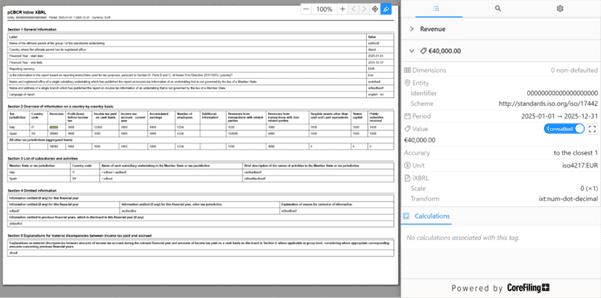
What does the tagging process look like?
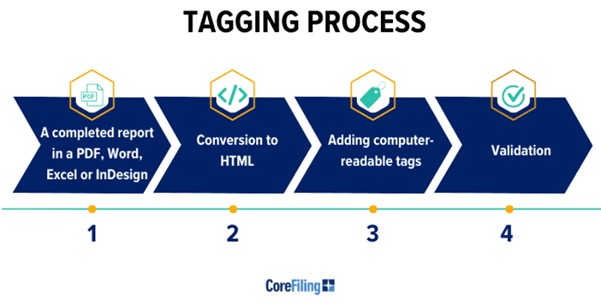
The vast majority of Inline XBRL reports are produced by bolt-on tagging tools. These allow the preparer to maintain their existing preparation processes, including their existing creative document design process. The tagging process for pCbCR starts with the finalised report in PDF, Word, Excel or even InDesign format and ends with an Inline XBRL document (.html/.xhtml/.htm) ready for submission. Tagging generally uses the following process:- A completed report in a PDF, Word,Excelor InDesign
- Conversion to HTML
- Adding computer-readable tags
- Validation
The pCbCR taxonomy
The pCbCR taxonomy published today, is aligned to the Commission Delegated Regulation published about a year ago. Each section of the taxonomy corresponds to each of the fix sections of the required disclosures. The tags listed below capture all the information disclosed in Section 3 of the report: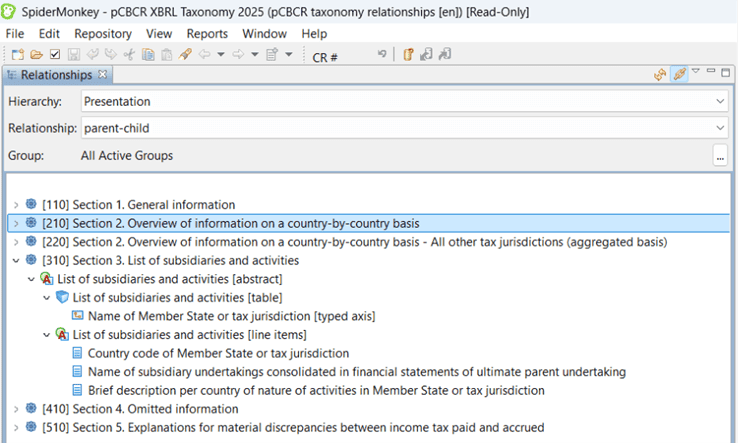
Applying a Tag
The conversion of the original document into HTML and the final validation is usually carried out automatically with no additional input from the user. The tagging itself is also able to be automated in several ways, but it is useful to start with an idea of how a manual tag is created.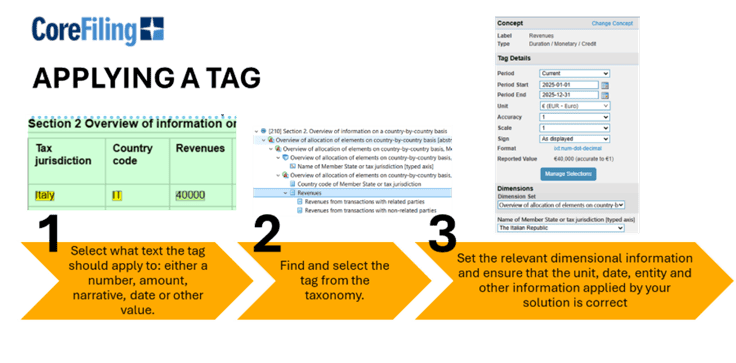
A Closer Look at the Seahorse Tagging Solution
At CoreFiling, we recognised early on that manually applying every tag in a report would be a laborious and tedious process, so much so, that errors would start to creep in. This is why there are several methods provided in our Seahorse tagging solution to speed up the process:
- Fuzzy Search: The most basic enhanced feature is a fuzzy search which allows you to quickly find a tag within the taxonomy by entering keywords. “Fuzzy” means that the words do not need to be exact in order to find what you are looking for.
- The AI Assistant: A much more advanced feature is the AI assistant which uses machine learning to suggest tags for selected text based on prior tagging decisions. This not only speeds up tagging, but promotes consistency between reports.
- Auto-Tagging: With auto-tagging, Seahorse will take each line item and automatically make calls to the AI assistant to create suggestions for entire tables. The confidence of the suggested tags is shown and, in most cases, the entire table can be accepted with a single click.
- Automatic Context: Units, dates and entity information are all entered automatically based on information provided up front and information on the page (such as currency symbols).
- Report Roll-forward: Once you have created an annual report, our roll-forward process allows you to copy the tags applied for second and subsequent years so you only need to work on new areas of reporting. The same process makes it easy to make last minute changes to the report without having to redo tagging.
Some companies choose to tag their own reports, however, it is becoming more common to use specialist tagging services, especially when the preparer only has to do this once a year. These services benefit from the experience and learnings of doing tens, hundreds or thousands of reports a year and can be very cost-efficient. CoreFiling has a number of partners that provide consistent and fast tagging for reports of any complexity.
While there are lots of ways to take the sting out of tagging, it is important to note that AI, auto-tagging and full service offerings do not reduce the responsibility on the company for the tagging that has been applied. The reporting company must own the tagging decisions and Seahorse provides a review spreadsheet for exactly this purpose along with a full audit trail and commenting features to track decision making.