
Large companies in the Netherlands are, for the first time, required to submit their financial statements to the Chamber of Commerce (Kamer van Koophandel, KvK) as digital reports. This brings KvK reporting further in line with the Dutch Standard Business Reporting (SBR) programme which aims to reduce the filing burden for businesses and increase the value of data collected through use of standardized definitions, formats and processes
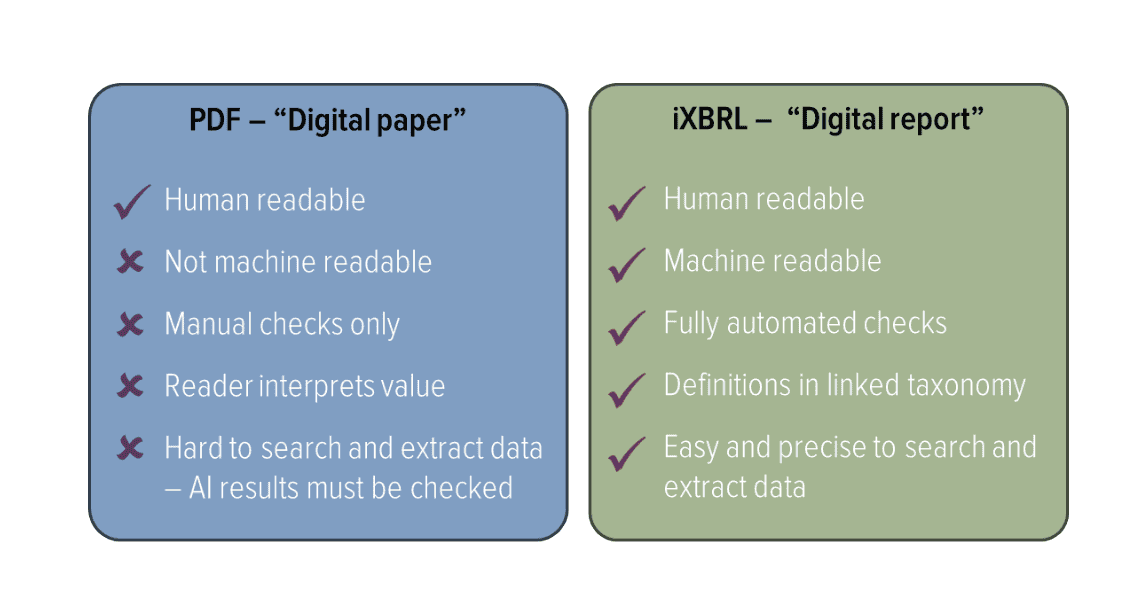
Businesses will already have some experience reporting with SBR for tax, credit or statistics reporting. The biggest change to affect large businesses (listed or otherwise) is that they must be sent in the SBR-approved iXBRL/XHTML format.
KvK set out the timeline for moving large businesses to iXBRL as follows:
- From 3rd February 2025 (for FY 2024): Voluntary filing in iXBRL allowed
- From 1st January 2026 (for FY 2025): Mandatory filing in iXBRL
When will I need a solution?
The standard reporting calendar for reporting financial statement to KvK still applies in 2026. Following the end of the financial year and in the normal course, large, non-listed businesses (BVs) have:- Five months to draw up the annual accounts and complete any audit activities
- Two months for shareholders to adopt the accounts
- Eight days to file with KVK
iXBRL, XHTML, tagging and taxonomies
The best thing to do first is to understand these terms. You will find that they arise when discussing or investigating KvK’s new iXBRL requirements, software and services. Knowing these terms will empower you get the solution you need: XHTML: XHTML is the format used to view websites on the Internet. It is just like a Word document (docx) or PDF document and can be viewed in any Internet browser. iXBRL: iXBRL files can be opened in a browser just like XHTML. What makes an iXBRL file special is the addition of computer readable tags. Opening an iXBRL file in an iXBRL viewer (like CoreFiling’s Beacon) allows you to see both the content and the tags. [link to “what is iXBRL”] Tagging: This is the process by which the computer readable tags are added to your report. When tagging, each figure or piece of narrative in your report is assigned a tag so the figure can be understood by automated systems. Taxonomy: This is the definition, published by SBR, of what tags must be used in your iXBRL. Viewing a taxonomy is like reading a dictionary of everything that can be reported in your financial statement.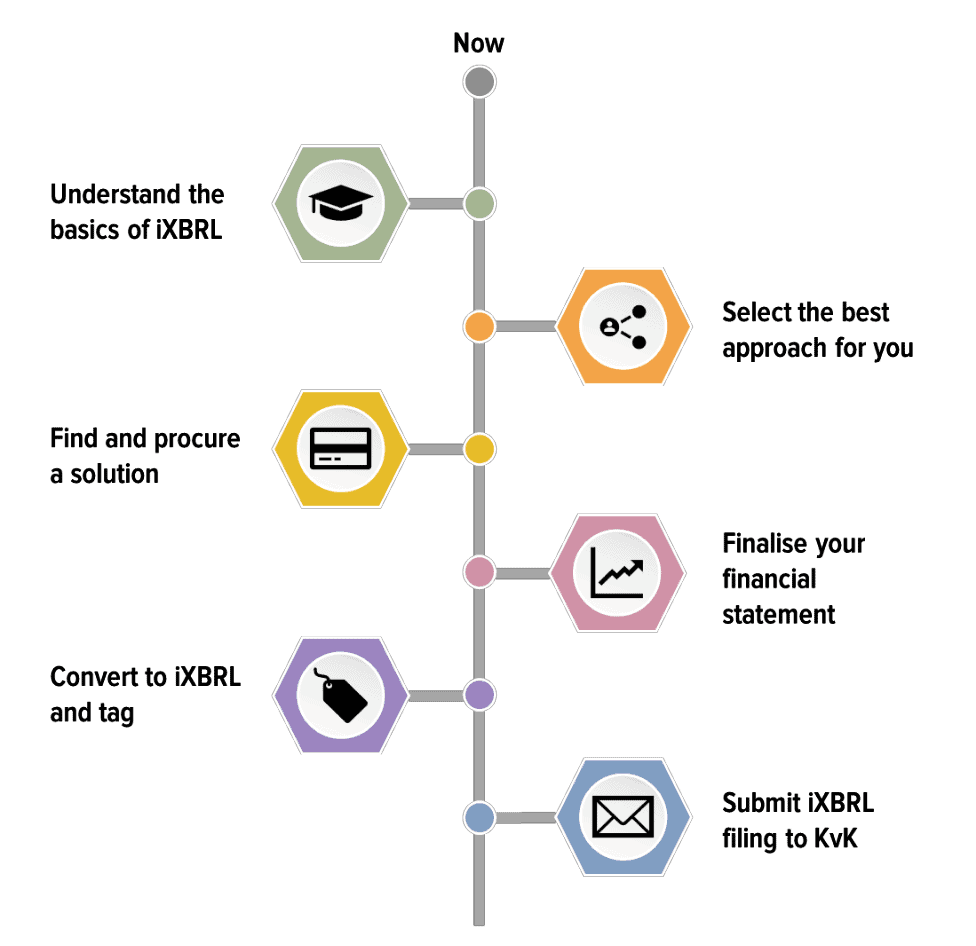
Steps to becoming compliant with the KVK changes
What should I do next?
Once armed with the terminology, the next step is to find a solution -most companies are actively looking now. Methods of creating iXBRL filings may be new to your business, but millions of businesses around the world have been creating their statutory and regulatory filings in iXBRL for decades. Companies like CoreFiling make it our business to help you be compliant. First, you should choose the solution that will work best for you:- You may already be able to export your financial statements in iXBRL

Look for the XBRL certified logo to be sure that any software you buy is capable of producing valid iXBRL.
When does tagging happen?
Using tagging services or self-service tagging are “bolt-on” processes and take place after the financial statements are audited and finalised. In other iXBRL reporting, these have proven to be the most popular ways to meet iXBRL requirements, the primary benefit is that no changes are required to other parts of the reporting process. At this point, you will have your full report in PDF or another format. This is the document you send to a service provider or upload into tagging software. Depending on the size and complexity of your report, the first time the financial statements are tagged, will take between a few hours and a day to complete. However, people usually allow a few weeks to allow for reviews, checking and in case any queries arise. Note that with Seahorse, this is sped up by the auto-tagging of tables and the AI assistant which offers suggested tags. Also, in subsequent years Seahorse will migrate the tags from the year, making the tagging much much faster!FAQ
Below are some frequently asked questions about KvK filing, please do not hesitate to get in contact with CoreFiling if you are unsure how your company can meet their iXBRL requirements.Who do the new iXBRL requirements apply to?
The change being discussed here relates to all large (public and private) businesses registered with KvK in the Netherlands.
When do I need to have my iXBRL ready?
Your iXBRL file must be ready to submit when you would usually submit your financial statement. For a BV business with a financial year aligned to the calendar year and no special circumstances, the latest this will be is the 8th August each year.
What is the point in collecting data in iXBRL format through the SBR programme?
The process of preparing accounts for iXBRL conversion makes financial data powerful. For example, a profit of “€50,000” is no longer just text on a page. It’s given a unique digital label like “Net Profit for the 2025 Fiscal Year.” This allows software to immediately find that specific data point and compare it across thousands of companies, effectively turning a library of static reports into a single, searchable database.
Why are KvK changing the filing rules for large businesses?
KvK use the Dutch SBR programme more generally to achieve an overall reduction in the effort required for businesses to communicate to government organisations. The move to iXBRL for large companies brings another part of KvK reporting into this programme.